


2024 vs 5056 vs 6061 vs 7075 Aluminum: Properties & CNC Comparison
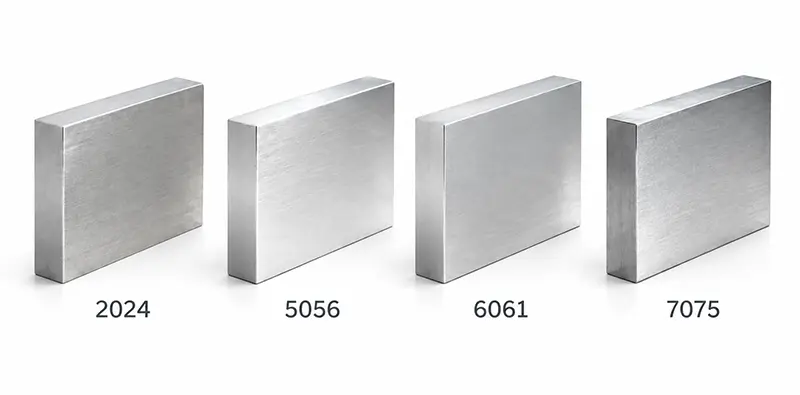
This article helps engineers and buyers choose between 2024, 5056, 6061 and 7075 aluminium by comparing their properties, CNC machinability and real application needs, showing that the best alloy is the one that best matches the part—not simply the strongest one.
Table of Contents
- 2024, 5056, 6061 and 7075 Aluminum Alloy Overview
- 2024 vs 5056 vs 6061 vs 7075 Aluminum Properties Comparison Table
- 2024 vs 5056 vs 6061 vs 7075 Mechanical Properties Comparison
- Corrosion Resistance and Weldability of 2024, 5056, 6061 and 7075 Aluminum
- 2024 vs 5056 vs 6061 vs 7075 Aluminum Applications
- 2024 vs 5056 vs 6061 vs 7075: Which Aluminum Alloy Should You Choose?
- CNC Machining 2024, 5056, 6061 and 7075 Aluminum at REKO
- FAQs About 2024, 5056, 6061 and 7075 Aluminum
- Conclusion
2024, 5056, 6061 and 7075 Aluminum Alloy Overview
Before comparing numbers, it helps to understand what makes these four alloys different. This section introduces the key aluminum alloy properties that influence material selection.
2024 Aluminum Properties
2024 aluminum properties are defined by high strength, good fatigue performance and a copper-rich 2xxx-series composition. Its main alloying element is copper. Kaiser describes 2024 rod and bar as having high strength and good machining characteristics, while its corrosion resistance is only fair.
Common tempers include 2024-T3, T351 and T851. 2024 can be a good choice when a component needs to carry repeated loads, but corrosion protection and joining requirements should be reviewed carefully.
5056 Aluminum Properties
5056 aluminum properties include very good corrosion resistance, high magnesium content and useful forming performance. 5056 belongs to the 5xxx series and contains roughly 4.5-5.6% magnesium. Unlike 2024, 6061 and 7075, it is a non-heat-treatable alloy whose properties are mainly controlled through strain hardening.
5056 performs well in salt-water environments and is commonly supplied as wire, rivet stock, bolt and screw stock and cold-heading material. [4] Common tempers include 5056-O, H32 and H34. It is therefore useful when corrosion resistance, forming or fastening performance matters more than maximum strength.
6061 Aluminum Properties
6061 aluminum properties offer a practical balance of strength, corrosion resistance, weldability, availability and manufacturing flexibility. 6061 is a 6xxx-series alloy based mainly on magnesium and silicon.
Common tempers include 6061-T6 and T651. 6061-T6/T651 rod and bar typically reaches about 310 MPa ultimate tensile strength and 276 MPa yield strength. Kaiser also rates its general corrosion resistance highly and its welding performance favourably. This combination makes 6061 practical for CNC machined components, frames, brackets, housings and industrial parts.
7075 Aluminum Properties
7075 aluminum properties are centred on very high strength, hardness and a high strength-to-weight ratio. 7075 is a 7xxx-series alloy, with zinc as its main alloying element together with magnesium and copper.
For example, 7075-T6/T651 rod and bar has typical values of about 572 MPa ultimate tensile strength and 503 MPa yield strength, making it considerably stronger than 6061-T6/T651. Common tempers include 7075-T6, T651, T73 and T7351. T73/T7351 trades some strength for improved stress-corrosion resistance, showing why the alloy number alone is not enough for material selection.
2024 vs 5056 vs 6061 vs 7075 Aluminum Properties Comparison Table
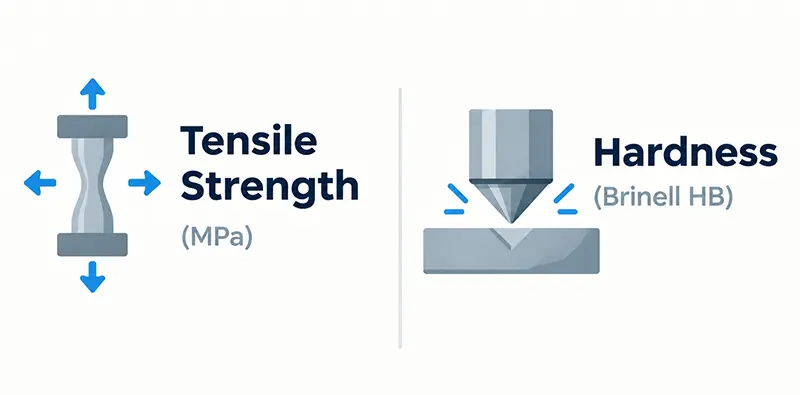
The following aluminum alloy properties table compares representative tempers of 2024, 5056, 6061 and 7075 aluminum, including density, tensile strength, yield strength, hardness, corrosion resistance, weldability and machining behaviour.
For 2024, 6061 and 7075, the mechanical values are based mainly on typical rod-and-bar data from Kaiser Aluminum. 2024-T4/T351 is listed at about 469 MPa tensile strength and 324 MPa yield strength; 6061-T6/T651 at about 310 MPa and 276 MPa; and 7075-T6/T651 at about 572 MPa and 503 MPa. For 5056-H32, published data varies with product form; a typical reference gives approximately 340 MPa tensile strength and 240 MPa yield strength.
| Property | 2024-T351* | 5056-H32* | 6061-T6/T651* | 7075-T6/T651* |
|---|---|---|---|---|
| Aluminium series | 2xxx | 5xxx | 6xxx | 7xxx |
| Main alloying element | Copper | Magnesium | Magnesium + Silicon | Zinc + Magnesium |
| Density | 2.77 g/cm³ | ≈2.70 g/cm³ | 2.70 g/cm³ | 2.80 g/cm³ |
| Ultimate tensile strength | ≈469 MPa | ≈340 MPa | ≈310 MPa | ≈572 MPa |
| Yield strength | ≈324 MPa | ≈240 MPa | ≈276 MPa | ≈503 MPa |
| Elongation | ≈19% | ≈10% | ≈17% | ≈11% |
| Brinell hardness | ≈120 HB | Varies by form | ≈95 HB | ≈150 HB |
| Corrosion resistance | Fair | Very good | Good | Fair |
| Weldability | Limited | Good to very good | Good | Limited |
| Machining behaviour | Good in suitable tempers | Depends strongly on form | Practical for general CNC work | Good; process control matters |
| Typical use | Aircraft & high-load parts | Rivets, fasteners, wire, corrosion-resistant parts |
General CNC & industrial parts | Aerospace & high-strength parts |
*Typical or representative values. Always check the required temper, dimensions, material standard and mill certificate before final design approval.
Typical or representative values. Always check the required temper, dimensions, material standard and mill certificate before final design approval. This aluminum strength comparison shows that 7075-T6/T651 gives the highest strength in this table, but that does not automatically make it the right alloy for every part.
2024 vs 5056 vs 6061 vs 7075 Mechanical Properties Comparison
When comparing 2024 vs 5056 vs 6061 vs 7075 aluminum mechanical properties, tensile strength and yield strength are useful starting points, but hardness, fatigue behaviour, environment and temper also matter.
Aluminum Tensile Strength Comparison
For the representative tempers above, the strength order is roughly 7075-T6/T651 > 2024-T351 > 6061-T6/T651, while 5056 depends strongly on the selected cold-worked temper and product form. 7075-T6/T651 reaches about 572 MPa tensile strength, compared with around 469 MPa for 2024-T351 and 310 MPa for 6061-T6/T651.
That difference can matter when section size and weight are tightly controlled. However, choosing 7075 simply because it is stronger may add material cost or introduce corrosion and joining concerns that the part does not need.
Aluminum Yield Strength Comparison
Yield strength is important when the designer needs to limit permanent deformation. In the representative data above, 7075-T6/T651 has the highest yield strength at about 503 MPa, followed by 2024-T351 at about 324 MPa, 6061-T6/T651 at about 276 MPa, and the cited 5056-H32 reference at about 240 MPa.
Aluminum Hardness Comparison
Typical Brinell hardness values from comparable rod-and-bar data are approximately 120 HB for 2024-T4/T351, 95 HB for 6061-T6/T651 and 150 HB for 7075-T6/T651. This gives 7075 an advantage where high surface hardness and load resistance are important.
Fatigue Performance of 2024 and 7075 Aluminum
2024 deserves special attention where components experience repeated cyclic loading. Kaiser lists 2024-T351 among alloys used for aerospace structures, hydraulic connectors and other strength-critical components. For a real engineering project, fatigue life cannot be decided from the alloy name alone: load direction, surface condition, stress concentration, environment and temper all matter.
Corrosion Resistance and Weldability of 2024, 5056, 6061 and 7075 Aluminum
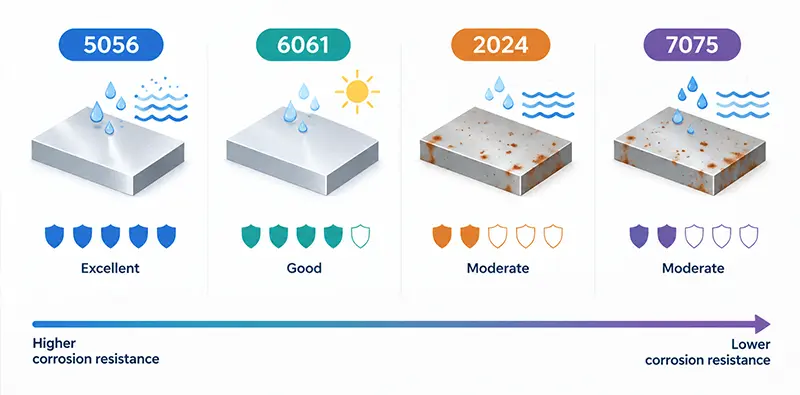
This aluminum corrosion resistance comparison shows a clear difference between magnesium-rich 5056, general-purpose 6061 and the higher-strength 2024 and 7075 alloys. Corrosion and joining requirements can change the material decision completely.
5056 Aluminum Corrosion Resistance
5056 aluminum corrosion resistance is one of the alloy’s key advantages. Its high magnesium content supports excellent corrosion resistance, including good performance in salt-water environments. This makes 5056 useful for corrosion-resistant fasteners, rivets, wire products and components exposed to moisture. Its applications still depend on the exact material form and specification.
6061 Aluminum Corrosion Resistance
6061 aluminum corrosion resistance is generally good for many industrial and outdoor applications. Kaiser rates 6061 favourably for general and stress-corrosion behaviour, depending on temper, and notes its good response to anodising. It is therefore practical for industrial equipment, outdoor components and machined parts that may later receive a surface finish.
2024 and 7075 Corrosion Considerations
2024 has only fair corrosion resistance. Its higher copper content contributes to strength but means corrosion protection deserves more attention. 7075 also requires careful consideration. Importantly, temper changes the result: 7075-T73/T7351 has lower strength than T6/T651 but improved stress-corrosion resistance. Kaiser lists typical yield strength of approximately 434 MPa for T73/T7351, compared with 503 MPa for T6/T651.
Can These Aluminum Alloys Be Welded?
6061 and 5056 are generally more suitable when welding is part of the design. 2024 and 7075 are normally treated with greater caution because fusion welding can lead to cracking or loss of mechanical properties. If a part must be both welded and highly loaded, the joining method should be considered before the alloy is selected.
2024 vs 5056 vs 6061 vs 7075 Aluminum Applications
Instead of asking which alloy is universally “best”, it is more useful to match each material to a real requirement. The following 2024 aluminum applications, 5056 aluminum applications, 6061 aluminum applications and 7075 aluminum applications show how the four grades serve different engineering needs.
2024 and 7075 Aluminum for Aerospace Applications
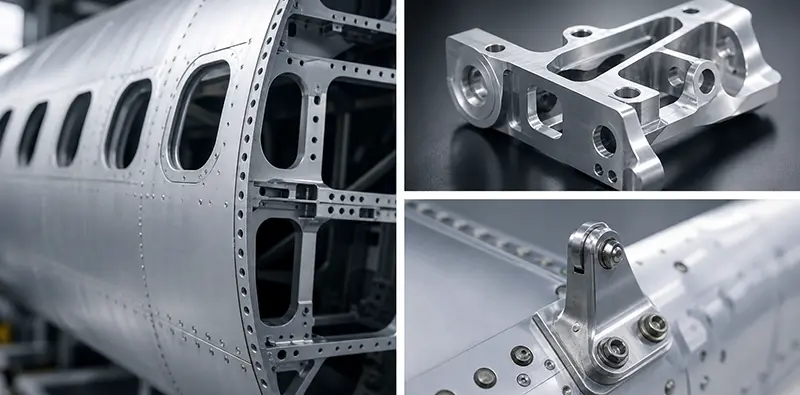
2024 and 7075 are major candidates for aerospace and high-load structures. Kaiser lists 2024 and 7075 tempers across aircraft applications such as fuselage frames, tail structures, fittings, hydraulic components and other high-strength parts. Use 2024 when fatigue performance, damage tolerance and machining characteristics fit the design; use 7075 when higher static strength is a major requirement.
6061 Aluminum for CNC Machined Parts
6061 is often a practical starting point for brackets, housings, fixtures, frames, machine components, prototypes, electronic enclosures and other CNC machined aluminum parts. It gives designers a useful balance without automatically paying for strength the part does not need.
5056 Aluminum for Corrosion-Resistant Fasteners and Components
5056 is well suited to rivet stock, wire, cold-headed fasteners, hinge pins, bolt and screw stock and components used in corrosive atmospheres. Published material information specifically lists wire, rivet stock and cold-heading uses for 5056.
7075 Aluminum for High-Strength Lightweight Parts
Where a design needs a high strength-to-weight ratio, 7075 becomes attractive for aerospace fittings, specialised machinery and other demanding components. If a part does not need this level of strength, 6061 or another grade may provide a simpler and more economical solution.
2024 vs 5056 vs 6061 vs 7075: Which Aluminum Alloy Should You Choose?
If you are asking which aluminum alloy should I choose, start with the part’s real requirement rather than the alloy name. A useful decision can often be made by asking a few practical questions.
| Project question | Alloy to consider first |
|---|---|
| Do I need very high static strength? | 7075 |
| Do I need high strength with strong fatigue performance? | 2024 |
| Is corrosion resistance a major priority? | 5056 or 6061, depending on form and design |
| Do I need a practical general-purpose CNC alloy? | 6061 |
| Will the part be welded? | 6061 or 5056 usually deserves closer review |
| Do I need aerospace structural performance? | 2024 or 7075, with the correct temper |
| Is stock availability and economical production important? | 6061 is often a practical starting point |
This table is a starting point, not a design rule. Before placing an order, check alloy + temper + material form + dimensions + applicable specification + required mechanical properties. For many buyers, the most common comparisons are 2024 vs 7075 aluminum, 5056 vs 6061 aluminum, and 6061 vs 7075 aluminum.
· 2024 vs 7075 aluminum: mainly a decision about fatigue behaviour, static strength, temper and corrosion requirements.
· 5056 vs 6061 aluminum: often comes down to stock form, corrosion resistance, heat-treatability, fabrication and the type of part being produced.
· 6061 vs 7075 aluminum: usually involves balancing practical manufacturing flexibility against much higher strength.
For example, specifying only “7075 aluminium” leaves an important question unanswered. A 7075-T651 part and a 7075-T7351 part do not have the same balance of strength and stress-corrosion performance. The same principle applies to 2024 and 6061.
CNC Machining 2024, 5056, 6061 and 7075 Aluminum at REKO
A material can look perfect in a datasheet and still create problems if the manufacturing route is not considered. REKO provides aluminum CNC machining services for suitable 2024, 5056, 6061 and 7075 projects, supporting CNC milling, CNC turning, surface finishing and inspection from prototypes to production parts.
For custom aluminum CNC machining, material selection can be reviewed together with the drawing, tolerances, surface finish, quantity and working environment. The discussion may include whether the specified temper is available, whether plate, bar or extrusion is required, whether residual stress can affect tight tolerances, whether anodising is needed, and whether the material cost is justified by the real load.
For more information about available aluminum materials, see REKO’s material page. For precision aluminum machining, the goal is simple: use enough material performance for the job, but do not pay for properties the part does not need.
FAQs About 2024, 5056, 6061 and 7075 Aluminum
Is 7075 Aluminum Stronger Than 6061 Aluminum?
Yes, when comparable high-strength tempers are considered. Typical 7075-T6/T651 rod-and-bar data gives approximately 572 MPa tensile strength and 503 MPa yield strength, compared with around 310 MPa and 276 MPa for 6061-T6/T651. That does not mean 7075 should replace 6061 in every design; 6061 offers better welding flexibility and good corrosion resistance at a lower level of mechanical strength.
2024 vs 7075 Aluminum: Which Is Better for Aerospace Parts?
They serve different needs. 7075 generally offers higher static strength, while 2024 is widely used where strength, fatigue behaviour and damage tolerance are important. Both alloys appear in established aerospace applications, but the correct temper and product form must be specified.
5056 vs 6061 Aluminum: What Is the Difference?
5056 is a non-heat-treatable, magnesium-rich 5xxx alloy known for corrosion resistance and applications such as wire, rivets and cold-heading stock. 6061 is a heat-treatable 6xxx alloy used much more broadly for structural fabrication and general CNC components.
Which Aluminum Alloy Is Best for CNC Machining?
There is no universal answer. 2024 has good machining characteristics. 6061 is widely used because of its complete balance of manufacturing properties. 7075 can also machine well and offers much higher strength. 5056 depends more strongly on the required stock form and temper. The drawing and application should decide the material.
6061 vs 7075 Aluminum: Which Is Easier to Machine?
The answer depends on temper, stock form and process conditions. Kaiser’s rod-and-bar ratings give 6061-T6/T651 and 7075-T6/T651 the same relative machinability grade C. 6061 is nevertheless widely used in commercial CNC work because its corrosion resistance, availability, fabrication flexibility and cost-performance balance are attractive.
Which Aluminum Alloy Has the Best Corrosion Resistance?
Within this four-alloy comparison, 5056 is particularly strong where corrosion resistance is important, while 6061 also performs well for many general environments. 2024 and 7075 require more careful corrosion consideration, and temper or surface protection may influence the final choice.
Can 2024 and 7075 Aluminum Be Welded?
They are generally not the first choices for conventional fusion-welded structures. Where welding is required, 6061 and suitable 5xxx-series alloys are usually easier starting points. Any critical welded component should follow the required engineering specification and qualified welding procedure.
What Is the Difference Between T6, T651 and T7351 Aluminum?
Temper identifies how an alloy has been heat treated, stretched or aged. T651 is generally a stress-relieved version of T6 for relevant wrought products, while 7075-T7351 uses an overaged condition to improve stress-corrosion resistance at some loss of strength. This is why a professional material specification should never stop at the four-digit alloy number.
Conclusion
2024, 5056, 6061 and 7075 aluminium are not four versions of the same material. They solve different engineering problems.
· 2024 combines high strength with useful fatigue performance and is widely used in aerospace and precision components.
· 5056 is valuable for corrosion resistance, wire, rivets, fasteners and cold-formed applications.
· 6061 provides a strong overall balance of mechanical performance, corrosion resistance, fabrication flexibility and commercial availability.
· 7075 provides the highest strength of the representative tempers in this comparison and is a strong option for demanding lightweight components.
Always compare the correct temper and material form before choosing an aluminium alloy. A decision made from the alloy number alone can lead to the wrong strength, corrosion performance, joining process or manufacturing cost.
For CNC projects, REKO can review the drawing, application and material requirements before production so that the selected alloy fits both the engineering requirement and the manufacturing process. The right material is not simply the strongest one. It is the one that gives the part exactly what it needs.
Need help choosing or machining the right aluminium alloy for your part? Contact REKO for a CNC machining quote and send us your drawing for review.