

Powder Coating vs Anodizing: Which Finish Is Better for Metal Parts?
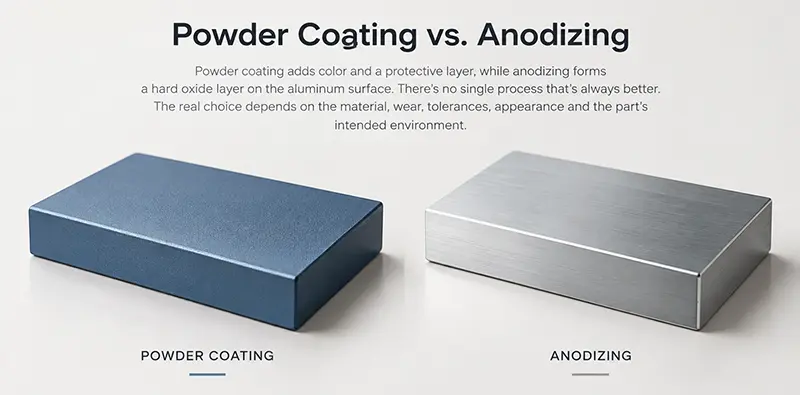
Powder coating adds colour and a protective film. Anodising creates a hard oxide layer on aluminium. Neither is always better. The right choice depends on material, wear, tolerance, appearance and where the part will be used.
Table of Contents
- Powder Coating vs Anodizing: Quick Comparison
- How Powder Coating and Anodising Work
- Powder Coating vs Anodizing: Key Differences
- How Do Powder Coating and Anodising Affect CNC Part Tolerances?
- Powder Coating vs Anodising for Aluminium Parts
- Powder Coating vs Anodising Cost
- Powder Coating or Anodising: Which Should You Choose?
- Common Applications of Powder Coating and Anodising
- Powder Coating vs Anodising FAQs
- Get the Right Surface Finish for Your Metal Parts
Powder Coating vs Anodizing: Quick Comparison
Powder coating and anodising can both protect metal parts, but they do it in very different ways. Powder coating gives more colour and a thicker outer layer. Anodising is often better when aluminium parts need wear resistance, a metal look and tighter dimensional control.
| Factor | Powder Coating | Anodising |
|---|---|---|
| Process | Adds a polymer film to the surface | Forms an oxide layer from the aluminium surface |
| Main materials | Aluminium, steel and other suitable metals | Mainly aluminium |
| Typical thickness | About 50–150 μm | Type II is usually thinner; Type III is thicker |
| Type II thickness | — | Often around 5–25 μm, depending on specification |
| Type III thickness | — | Often around 35–50 μm, depending on specification and use |
| Colour choice | Very wide | More limited |
| Metal appearance | Covered by the coating | Metal look can remain visible |
| Wear resistance | Good | Very good, especially Type III |
| Impact behaviour | Thicker film can handle impact well | Hard surface is strong against wear but less flexible |
| Dimensional impact | Higher | Usually lower with Type II; Type III needs more care |
| Threads and bores | Often need masking | May need masking or machining allowance |
| Electrical contact | Critical areas normally need masking | Oxide layer is electrically insulating |
| Repair | Easier to recoat | Local repair is more difficult |
| Common use | Frames, covers, housings | CNC parts, fittings, precision aluminium parts |
*Thickness values are typical ranges only. Actual requirements depend on the finish specification, part shape and supplier process.
For colour, coverage and a thicker outer layer, powder coating is often a strong choice. For precision aluminium parts, wear resistance and a clean metal look, anodising is often the better starting point.
How Powder Coating and Anodising Work
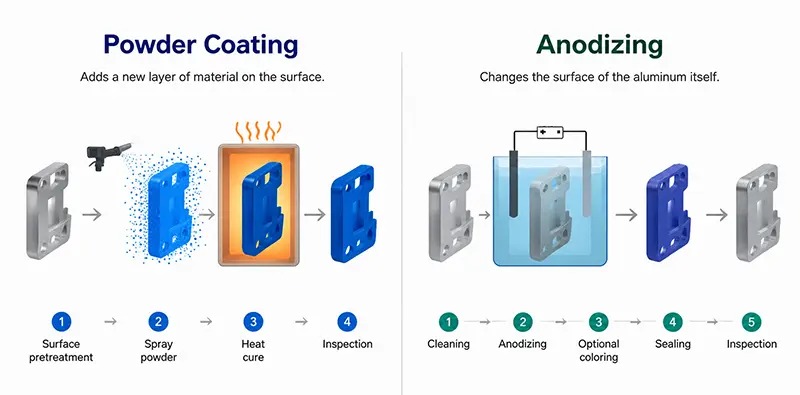
The main difference is simple.Powder coating adds a new layer. Anodising changes the aluminium surface itself.
How Powder Coating Works
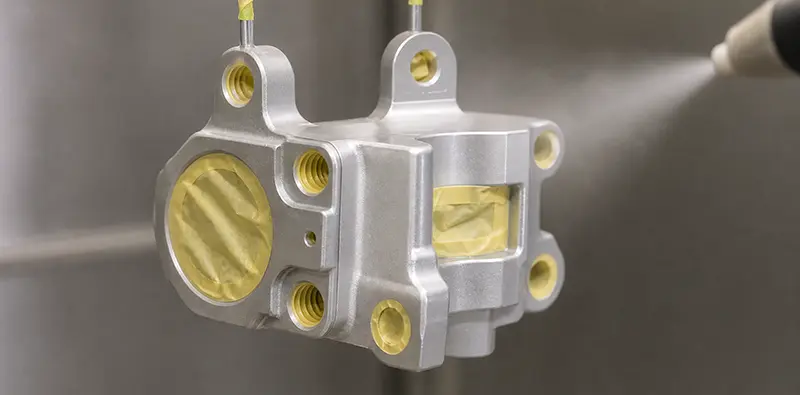
Powder coating uses dry powder that is sprayed onto a prepared metal surface with an electrostatic charge. The part is then heated so the powder flows and cures into a solid film.
The basic process is: Surface preparation → Powder spraying → Curing → Inspection
Because the film sits on top of the metal, it can give strong coverage, many colours and different textures.
How Anodising Works
Anodising uses an electrochemical process. The aluminium part is placed in a bath, and an electric current helps build a controlled aluminium oxide layer.
A common process is: Cleaning → Anodising → Dyeing if required → Sealing → Inspection
The oxide layer becomes part of the aluminium surface rather than sitting on it like paint. This is why anodising can keep more of the original metal feel and fine part detail. Powder coating and anodising are only two options available for machined parts. You can also explore REKO's surface finishing options for different materials and applications.
Powder Coating vs Anodizing: Key Differences
The choice becomes much easier when you look at how the finishes behave in real use.
Coating Thickness
Powder coating normally creates a much thicker outer layer than standard anodising. A powder-coated part may have around 50–150 μm of coating, while standard Type II anodising is normally much thinner. That does not mean thinner is always better. A thick finish can give good coverage and protection. A thin finish can be useful when small features and dimensions matter. We look at the effect on precision features in more detail in the tolerance section below.
Corrosion Resistance
Both finishes can improve corrosion resistance when the process is designed correctly. Powder coating forms a barrier between the base metal and the environment. Anodising strengthens the aluminium oxide layer itself. Performance depends on more than the process name. Surface preparation, coating thickness, sealing, damage, alloy and the working environment can all affect the final result. Do not choose a finish from a corrosion claim alone. Look at the real environment of the part.
Wear, Scratch and Impact Resistance
These are not the same thing. Hard anodising is especially useful for surfaces that face sliding, rubbing or repeated wear. Powder coating has a thicker and more flexible polymer film. It may perform well where the surface needs to handle normal knocks and impact. So a harder surface is not automatically better for every part. For abrasion and sliding wear, hard anodising is often a strong option. For colour coverage and a tougher outer film, powder coating may make more sense.
Colour and Appearance
Powder coating gives much more freedom in colour.
You can choose:
· Matte
· Gloss
· Satin
· Textured finishes
· Many standard and custom colours
Anodising keeps more of the aluminium look. Clear, black and coloured anodised finishes are available, but the final shade can change with the aluminium alloy and process. This is important when several visible parts must match closely.
Outdoor and UV Performance
Both finishes can be used outdoors, but the exact finish needs to match the environment. Outdoor-grade powder coatings are widely used on frames, enclosures and covers. Anodised aluminium is also common in products exposed to weather. For demanding outdoor parts, ask about the exact powder system, anodising specification, colour stability and required corrosion performance rather than simply asking whether the finish is “outdoor safe”.
Electrical Properties
Anodised aluminium has an oxide layer that acts as an electrical insulator.
This can be a problem if the part needs:
· Grounding
· Electrical contact
· Conductive mounting points
· These areas may need masking.
Powder coating also covers the metal with a non-conductive film, so electrical contact areas normally need to be identified before coating.
Repair and Maintenance
Powder-coated parts can often be stripped and recoated if necessary. Anodising is part of the aluminium surface, which makes local cosmetic repair more difficult. At REKO, we therefore look at use, wear, appearance, assembly and critical dimensions together, rather than choosing a finish from one performance point.
How Do Powder Coating and Anodising Affect CNC Part Tolerances?
For precision parts, this can be more important than colour. Surface finishing changes the final surface of the part. If that change happens on a critical feature, a part that was correct after machining may no longer fit correctly after finishing.
Coating Build-Up and Dimensional Change
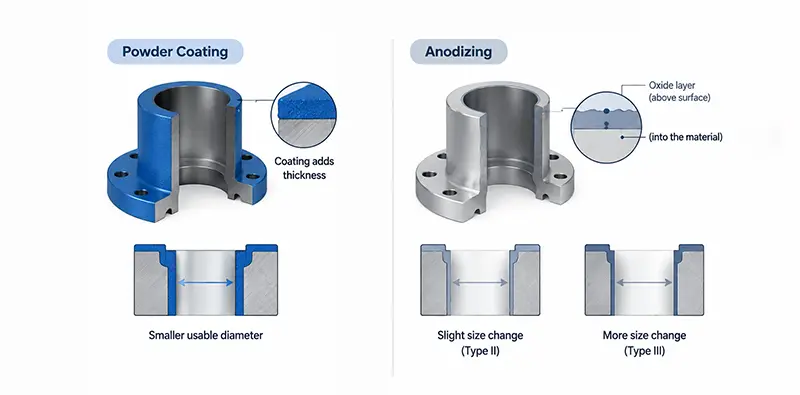
Powder coating adds a film on top of the base metal. If both sides of a hole or slot receive coating, the usable opening becomes smaller. Anodising behaves differently. The oxide layer grows partly into the aluminium and partly above the original surface. Standard Type II anodising normally causes less build-up than powder coating, but it should still be included in tolerance planning. Type III hard anodising is thicker and needs even more care around precision features. No finish should be ignored when the drawing contains tight final dimensions.
Threads, Holes and Precision Fits
Features that deserve special attention include:
· Internal and external threads
· Reamed holes
· Bearing seats
· Press fits
· Sliding surfaces
· Sealing faces
· Precision bores
· Mating surfaces
For example, imagine an aluminium housing with a precision bearing bore. If the bore is machined exactly to its final size and then receives a thick surface finish, the bearing may no longer fit as planned. The solution could be masking, machining allowance or another finishing plan. The drawing should define the finished-part requirement, not only the size before coating.
When Is Masking Required?
Masking stops the finish from reaching selected areas.
It is often considered for:
· Threads
· Bearing seats
· Precision bores
Grounding points
· Electrical contacts
· Sealing areas
· Critical mating faces
· Masking should be decided before production starts.
At REKO, the key question is simple: Which surfaces must look finished, and which surfaces must still fit, move, seal or conduct electricity afterwards? Answering that early can prevent expensive rework.
Powder Coating vs Anodising for Aluminium Parts
Aluminium is where the choice between these two finishes becomes especially important.
Both can work well. They simply solve different problems.
When to Choose Powder Coating for Aluminium
Powder coating is worth considering when the part needs:
· A wide choice of colours
· Matte, gloss or textured appearance
· A fully covered painted look
· A thicker outer film
· Good protection for housings, covers or frames
A large aluminium enclosure, for example, may benefit more from powder coating if colour and appearance are the main goals.
When to Choose Anodising for Aluminium
Anodising is often suitable when the part needs:
· Good abrasion resistance
· A metallic appearance
· Fine surface detail
· Tighter control around precision features
· A hard aluminium surface
· Good corrosion protection
This makes anodising common for CNC machined brackets, housings, fittings and mechanical parts.
Type II vs Type III Anodising
Type II and Type III should not be treated as the same finish.
| Factor | Type II Anodising | Type III Hard Anodising |
|---|---|---|
| Main purpose | General protection and appearance | High wear and harder service |
| Typical layer | Thinner | Thicker |
| Typical thickness | Often 5–25 μm | Often 35–50 μm, depending on specification |
| Colour options | Better for decorative colours | More limited |
| Wear resistance | Good | Higher |
| Dimensional effect | Lower | Greater |
| Common use | Housings, visible CNC parts, general components | Wear parts, sliding parts, demanding mechanical parts |
Hard anodising is not automatically the better finish. If a part has very tight fits, the extra oxide thickness of Type III may need more allowance or masking. Choose it because the application needs the wear performance, not simply because “hard” sounds better.
How Aluminium Alloy Affects Anodising Results
Not all aluminium alloys anodise in exactly the same way.
Grades such as 5052, 6061, 6063 and 7075 have different alloy compositions. That can affect:
· Final shade
· Surface appearance
· Colour consistency
· Response to the anodising process
Heat treatment, machining marks and surface preparation also affect appearance. This matters when a product contains several visible aluminium parts. Using the same anodising colour does not guarantee a perfect visual match between different aluminium grades or material batches. For cosmetic parts, REKO recommends confirming material grade and appearance requirements before production.
Powder Coating vs Anodising Cost
There is no fixed answer to which finish is cheaper. The real cost depends on the part.
What Affects Powder Coating Cost?
Important cost factors include:
· Part size
· Surface area
· Powder type
· Colour
· Texture
· Quantity
· Surface preparation
· Masking
· Inspection requirements
Standard colours and larger batches can often be more cost-effective. Custom colours, special textures and complex masking usually add cost.
What Affects Anodising Cost?
Important factors include:
· Aluminium grade
· Type II or Type III
· Required thickness
· Colour
· Part size
· Quantity
· Masking
· Cosmetic requirements
· Inspection requirements
Type III hard anodising generally costs more than standard Type II because the process and coating requirements are more demanding. But finish price is only one part of the decision. Imagine saving money on the coating but then finding that a bearing bore, thread or press fit needs rework. That is not a saving. The lowest finishing price does not always give the lowest finished-part cost. At REKO, we look at machining, finishing, masking, inspection and assembly risk together.
Powder Coating or Anodising: Which Should You Choose?
There is no universal winner. Use the part requirement as the starting point.
| If Your Priority Is... | A Good Starting Point |
|---|---|
| Wide colour choice | Powder coating |
| Custom texture or gloss | Powder coating |
| Clean metallic appearance | Anodising |
| Sliding or abrasive wear | Hard anodising |
| Thick outer film | Powder coating |
| Precision aluminium features | Type II anodising may be easier to manage |
| High-wear aluminium parts | Type III hard anodising |
| Large outdoor frames or covers | Powder coating is often considered |
| Tight bores or threads | Review thickness and masking before choosing |
| Grounding or electrical contact | Plan masking with either finish |
Before making the final choice, ask five questions.
1. What Is the Material?
If the part is steel, anodising aluminium is not the comparison you need. If the part is aluminium, both processes may be possible.
2. Where Will the Part Work?
Think about: Water, salt, sunlight, heat, chemicals, friction and impact. The working environment matters more than a simple “indoor” or “outdoor” label.
3. Which Dimensions Are Critical?
Check the drawing for: Threads, bearing seats, bores, press fits, seals and mating faces. A finish should never be chosen without looking at these areas.
4. What Appearance Does the Customer Need?
Choose powder coating when strong colour control and full surface coverage matter. Choose anodising when the part should still look and feel like aluminium.
5. What Performance Is Really Needed?
Do not pay for Type III hard anodising when a normal decorative finish is enough. And do not choose a cosmetic finish when the surface faces heavy wear. The right finish is the one that meets the real job without adding performance or cost you do not need.
Common Applications of Powder Coating and Anodising
The industry name alone should not decide the finish. Two parts used in the same machine can need completely different surface treatments.
| Application | Common Option | Why |
|---|---|---|
| CNC aluminium housing | Anodising / Powder coating | Depends on tolerance, appearance and environment |
| Precision mechanical part | Anodising | Thin finish and good wear properties |
| Sliding aluminium component | Hard anodising | Higher wear resistance |
| Outdoor frame | Powder coating | Colour range and full surface coverage |
| Electronic enclosure | Both | Depends on appearance, grounding and assembly |
| Bracket or fitting | Anodising | Suitable for many machined aluminium parts |
| Decorative housing | Both | Choice depends on metal look versus coated colour |
| Large coloured enclosure | Powder coating | Wide colour and texture options |
Choose the finish for the function of the part, not simply for the industry it belongs to.
Powder Coating vs Anodising FAQs
Is anodising better than powder coating?
Not in every case.
Anodising is often a good choice for aluminium parts that need wear resistance, a metallic look and tighter control around precision features.
Powder coating offers more colour options and a thicker outer film.
The correct choice depends on the part.
Which lasts longer, anodising or powder coating?
There is no single service-life number that applies to every part.
Life depends on the finish specification, environment, surface preparation, wear, UV exposure and maintenance.
The right question is: Which finish is designed for the real conditions of my part?
Is powder coating cheaper than anodising?
Sometimes.
But price changes with size, quantity, colour, thickness, masking and inspection.
For precision components, total manufacturing cost matters more than finish price alone.
Can aluminium be powder coated?
Yes.
Powder coating is widely used on aluminium housings, covers, frames and other components.
Good surface preparation is important for coating adhesion and long-term performance.
Does anodising affect dimensions?
Yes.
The oxide layer changes the final surface.
Type II usually has a smaller dimensional effect than a thick powder coat, while Type III hard anodising needs more attention on tight features.
Does powder coating affect tolerances?
Yes.
Its thicker external film can reduce hole size, change mating areas and cover fine features.
Masking or extra clearance may be needed.
What Thickness Should I Specify for Powder Coating or Anodising?
Do not copy one thickness into every drawing.
The required thickness depends on the process, application and specification.
As a general guide, powder coating is often around 50–150 μm, Type II anodising is usually thinner, and Type III hard anodising is thicker.
For a critical part, specify the required standard or performance rather than guessing.
Should Threads and Precision Holes Be Masked?
Often, yes, but not always.
It depends on the finish thickness, thread size, final tolerance and function.
The drawing should clearly identify any surfaces that must remain free from coating.
Get the Right Surface Finish for Your Metal Parts
A surface finish should not be decided after machining is complete. At REKO, we prefer to review finishing requirements with the drawing from the start.
A typical review follows this path: Drawing → Material → Critical Dimensions → Finish → Masking → Inspection
A Typical CNC Finishing Case
A customer needed aluminium CNC parts with a clean finished appearance and accurate fitting areas. The challenge was not simply making the parts look good. The critical bores and mating surfaces still had to work after finishing. REKO reviewed the drawing before production, identified the functional surfaces and planned the finishing and masking requirements around them. This avoided treating every surface in the same way.
The goal was simple: the finished part had to look right and still fit as designed. That is the difference between choosing a finish from a colour chart and planning it as part of the manufacturing process.
You can explore REKO's surface finishing options for machined metal parts.
Not sure what to specify on your drawing?
Send REKO your drawing, material, required colour, tolerance and working environment. We can review the critical features, masking areas and finishing requirements before production.
The finish should protect your part — not create a new problem.