


REKO Adds 2 Five-Axis and 4 Four-Axis Machines to Expand CNC Machining Capacity
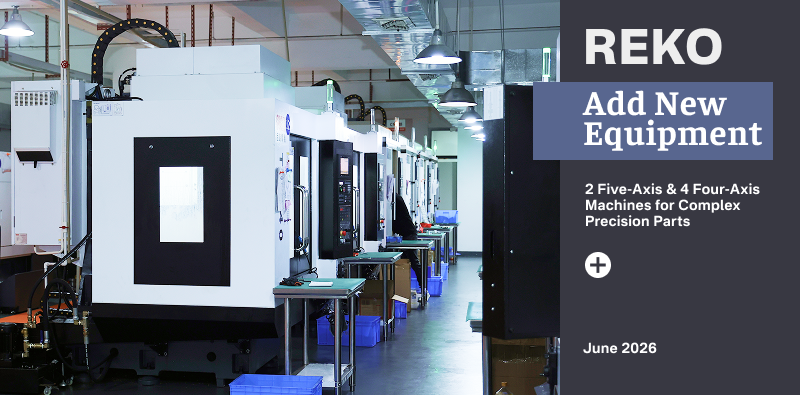
REKO has added 2 five-axis and 4 four-axis CNC machines to expand machining capacity. The new machines provide more process and scheduling choices for complex parts, prototypes, repeat orders, and batch production across different industries.
Table of Contents
Why REKO Keeps Adding CNC Machines
REKO mainly serves customers in the motorcycle, automotive, bicycle, aerospace, medical equipment, sensor, hydraulic, robotics, and automation industries.
These customers usually do not need standard parts in one fixed size. They need custom CNC parts made from 2D engineering drawings, 3D models, and project needs. Different projects can be very different in shape, material, size, tolerance, surface quality, and order quantity. Because of this, they may need different machines and machining plans.
Some parts mainly have flat surfaces, holes, and slots, so normal three-axis machines can make them. Some parts have several sides, holes around the part, or turning and indexing features, so four-axis machining may be a better choice. Other parts may have angled holes, complex shapes, many machining angles, or areas that a tool cannot reach from a normal direction. These parts may need a five-axis machining review.
When REKO reviews a custom CNC project, we usually need the following information:
· Drawings: 2D or 3D files (CAD/PDF/DWG/IGS/STEP/JPG files)
· Material grade (aluminum/stainless steel/steel/copper/plastic)
· Order quantity
· Key tolerances
· Surface roughness
· Surface finish needs
· Heat treatment needs
· Inspection needs
· Packing needs
· Target delivery time
This information directly affects machine choice, clamping method, tool plan, machining steps, machining time, and inspection method.
When many different projects must share a small number of machines, samples, repeat orders, and batch orders may compete for the same machine time. This can also reduce the freedom of production planning.
By adding 2 five-axis machines and 4 four-axis machines, REKO can provide more machine resources for projects with different shapes, sizes, and production stages. Samples, first articles, low-volume projects, repeat orders, and later batch production can all be arranged more freely based on the actual process needs and machine schedule.
It is important to note that adding machines does not mean every project can start at once, and it cannot promise a shorter delivery time for every order. Material buying, part difficulty, tool and fixture preparation, surface finishing, and inspection needs can still affect the real production time. However, more machines can reduce the chance that many projects must wait for the same type of machine. They also give the engineering and production teams more choices.
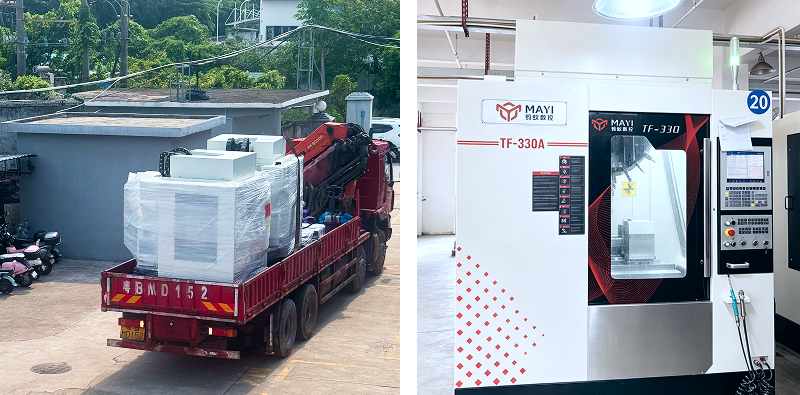
The New Five-Axis and Four-Axis Machines

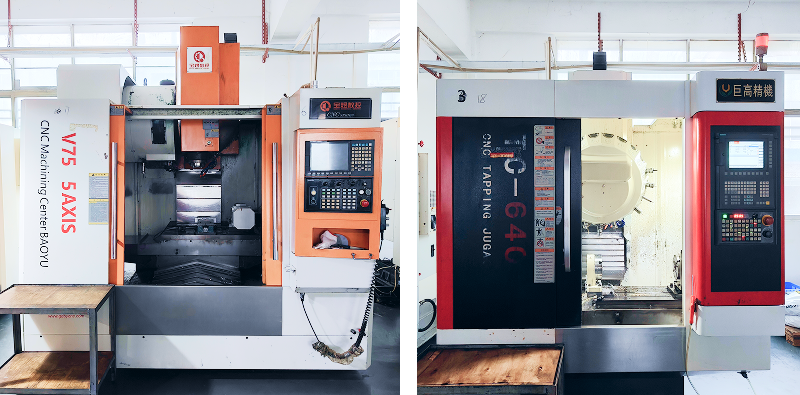
1. BAOYU V75 Five-Axis Machine
This type of machine is better for reviewing smaller parts that have complex shapes and need machining from several directions. For projects with small parts that also have angled surfaces, angled holes, multi-angle shapes, and several assembly faces, a five-axis machine can give the cutting tool more ways to reach the part.
What machining needs can it support?
Five-axis machining usually has three straight movement directions, X, Y, and Z, plus two turning directions. Compared with normal three-axis machining, a five-axis machine can let the tool reach the workpiece from more directions.
This movement may help machine:
· Flat surfaces at several different angles
· Angled holes and angled slots
· Complex curved surfaces
· Parts where several machined faces must keep the correct position to each other
· Shapes that are hard for the tool to reach from normal directions
· Parts that need fewer repeated clamping steps
· Small parts with many shape features
For parts that need to be turned over several times, every new clamping step may bring new positioning and reference changes. With a five-axis machine, some shapes can be finished in one clamping or with fewer clamping steps. This can lower the risk of added position errors from repeated setup.
A five-axis machine is not always the best choice for every complex part. Some parts are complex, but when the quantity is large, a three-axis machine with a special fixture may give more stable production. Some parts mainly have features around one turning direction, so a four-axis machine may be the more direct choice.
Part types that may be suitable for review include:
· Motorcycle brackets
· Footpegs and related connecting parts
· Handlebar clamps
· Complex adapters
· Sensor housings
· Precision aluminum housings
· Drone structure parts
· Robot connecting parts
· Automotive mounting brackets
· Small structure parts with several angles
The list above only shows part types that may be suitable for a five-axis review. It does not mean every similar part can be made directly. The actual machining method still needs to be checked from the detailed drawings, material, and tolerance needs.
2. JUGAO 640 Four-Axis Machine
Four-axis machining usually adds one turning axis to the three straight movement axes, X, Y, and Z. The workpiece can turn or move to set angles around one direction, so the tool can machine different sides or features around the part.
Four-axis machines are often a good choice for parts with side holes, holes around the part, several machined faces, or turning and indexing features.
For projects that do not need full five-axis movement but do need fewer manual turning and repeated positioning steps, four-axis machining may better match real production needs.
What machining needs can it support?
Four-axis machining usually adds one turning direction to three-axis machining. A rotary table can turn the workpiece or move it to set angles, so the tool can machine features around the part or on several sides.
Four-axis machines are often used for the following shapes:
· Holes and slots on the sides of round parts
· Holes placed around a circle
· Machined features on several sides
· Shapes that need fixed-angle indexing
· Parts with repeated angle features
· Parts that need less manual turning
· Features around shafts or connector parts
For example, a round connector may need several side holes at different angles. On a normal three-axis machine, the operator may need to remove, turn, and position the part again several times. With a four-axis rotary table, the workpiece can turn to the set angles, so several features around the part can be made from the same clamping position.
This can reduce some manual repositioning steps and lower the risk of position differences between sides caused by repeated clamping.
Part types that may be suitable for review include:
· Hydraulic valve bodies
· Hydraulic fittings
· Shaft parts with side holes
· Round connectors
· Multi-side brackets
· Fixtures and clamping blocks
· Adapters with indexed holes
· Multi-side housings
· Industrial parts with features around the part
Four-axis machining is not simply a replacement for five-axis machining. The two machine types are suitable for different shapes.
When a part mainly needs to turn around one direction so different sides or round features can be machined, four-axis machining may better match the process. When a part has many complex angles, curved surfaces, or tool reach problems, a five-axis plan may need to be reviewed.
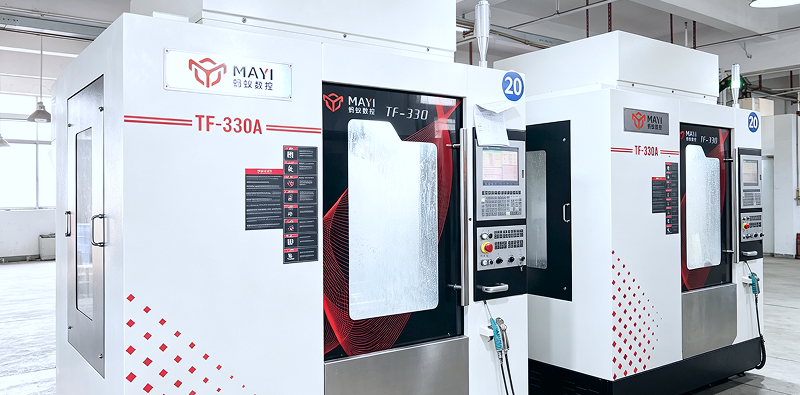
What the New Machines Can Bring to Customer Projects
1. More Process Choices
The new five-axis and four-axis machines have different movement methods and working ranges. They can give more machining choices for parts with different sizes and shapes.
The BAOYU V75 five-axis machine is better for reviewing smaller complex parts with several machining angles. The JUGAO 640 four-axis machine can support multi-side machining and turning or indexing work over a larger working range.
After a customer provides drawings, REKO can review the part shape, size, material, tolerances, and order quantity to decide whether a three-axis, four-axis, or five-axis machine is more suitable.
2. More Scheduling Choices for Samples and First Articles
New product development usually does not go straight into batch production. A customer may go through the following stages:
· Design and drawing preparation
· Machining review
· Sample machining
· First article inspection
· Assembly test
· Function test
· Design changes
· Low-volume testing
· Full batch production
The main goal of the sample stage is not only to make the part. It is also to check:
· Whether the drawings are complete
· Whether the design is suitable for production
· Whether key sizes are reasonable
· Whether assembly works well
· Whether the material fits the use
· Whether the surface finish meets the needs
· Whether changes are needed before batch production
The new machines give more scheduling choices for sample and first article projects. However, sample delivery time still depends on material, tools, fixtures, machining steps, surface finishing, and inspection needs.
3. More Machine Resources for Repeat Orders and Batch Projects
After sample testing, a customer may slowly move into low-, medium-, or high-volume production.
Batch production needs enough machine resources, and it also needs the following items to stay under control:
· The same drawing version
· The same material needs
· Controlled machining programs
· Checks of key sizes
· Clear appearance standards
· Clear surface finish needs
· Stable packing methods
· Production and inspection records that can be traced
The new machines can give more machining resources for repeat orders and batch projects. However, more machines do not automatically promise stable batch quality. Stable production still depends on first article approval, checks during production, tool control, and final inspection before shipping.
4. More Flexible Production Planning
When several projects need four-axis or five-axis machining at the same time, more machines can help the production team plan machine use and production time more freely.
This added freedom may include:
· Choosing different machines based on part size
· Choosing a four-axis or five-axis plan based on the part shape
· Arranging projects from different customers at the same time
· Keeping more production resources for repeat orders
· Reducing the pressure of putting all complex projects on only a few machines
· Balancing sample and batch projects
However, REKO will not start production only because a machine is free. Every project still needs drawing review, material check, and process planning.
New product development usually does not go straight into batch production. A customer may go through the following stages:
· Design and drawing preparation
· Machining review
· Sample machining
· First article inspection
· Assembly test
· Function test
· Design changes
· Low-volume testing
· Full batch production
The main goal of the sample stage is not only to make the part. It is also to check:
· Whether the drawings are complete
· Whether the design is suitable for production
· Whether key sizes are reasonable
· Whether assembly works well
· Whether the material fits the use
· Whether the surface finish meets the needs
· Whether changes are needed before batch production
The new machines give more scheduling choices for sample and first article projects. However, sample delivery time still depends on material, tools, fixtures, machining steps, surface finishing, and inspection needs.
Which Industry Projects May Fit the New Machines
Motorcycle Parts
Custom motorcycle parts usually need a good balance of shape, assembly, and appearance.
Parts that may be suitable for four-axis or five-axis review include:
· Footpegs
· Brackets
· Handlebar clamps
· Levers
· Engine covers
· Adapters
· Suspension-related parts
· Performance upgrade parts
Some motorcycle parts have several machined faces and complex shapes. They may also need anodizing, sandblasting, polishing, or laser marking. The machining plan must consider both the final size and the final look after surface finishing.
Custom Automotive Parts
REKO can review the following types of custom automotive parts from customer drawings:
· Suspension-related parts
· Engine-related structure parts
· Transmission-related parts
· Vehicle interior control parts
· Mounting brackets
· Housings
· Adapters
Other custom automotive parts
REKO provides custom CNC part machining. This does not mean that we make complete engines, gearboxes, or full vehicle systems.
Sensor Parts
Sensor parts are usually small, but their assembly, threads, and connection sizes often need close control.
Common parts include:
· Sensor housings
· Threaded bodies
· Connectors
· Protective housings
· Small precision structure parts
A small size difference may stop a part from fitting, cause a seal to fail, or put a connection in the wrong position. Because of this, key sizes need close attention during machining and inspection.
Hydraulic Parts
Hydraulic projects may include:
· Hydraulic valve bodies
· Hydraulic blocks
· Parts with internal passages
· Threaded fittings
· Parts machined on several sides
Besides sizes and threads, hydraulic parts also need attention to inner burrs, clean passages, and sealing faces.
Bicycle and E-Bike Parts
Parts that may be suitable for four-axis or five-axis review include:
· Clamps
· Mounting brackets
· Connecting rods
· Spacers
· Lightweight structure parts
· Motor mounts
· Suspension-related parts
Bicycle parts usually need a balance between low weight, strength, assembly, and surface appearance.
Robotics, Automation, and Industrial Equipment Parts
These projects may include:
· Robot connectors
· Automation equipment brackets
· Positioning parts
· Fixtures
· Housings
· Shaft parts
Custom replacement parts
Medical Equipment Parts
Some medical equipment parts are small, but they may have several machined faces, precision holes, threads, fitting areas, and complex shapes at the same time. Parts that may be suitable for four-axis or five-axis machining review include:
· Medical testing equipment housings
· Medical instrument brackets
· Mounting parts for optical or testing equipment
· Precision positioning parts
· Equipment connectors
· Valve bodies and fluid control parts
· Metal structure parts for handheld medical instruments
Medical automation equipment parts
Aerospace-Related Structure Parts
Aerospace-related parts often need a balance between low weight, strength, assembly position, and stable size. Some parts may have thin walls, many angles, several machined faces, complex shapes, or many weight-reduction areas. Because of this, clamping, tool paths, and machining order need careful planning.
Parts that may be suitable for four-axis or five-axis machining review include:
· Lightweight mounting brackets
· Equipment housings
· Sensor mounts
· Communication equipment structure parts
· Drone structure parts
· Aerospace test equipment parts
· Ground support equipment parts
· Multi-angle connectors
· Custom structure parts that are not critical flight parts
Five-axis machines can be used to review shapes with several angled faces, angled holes, complex outlines, and limited tool space. Fewer repeated clamping steps may help keep the correct position between several machined faces.
Learn More About REKO
REKO is a custom CNC machining factory in Shenzhen, China. It was founded in 2016 and mainly supports overseas B2B customers with precision part machining.
Our main services include:
· CNC milling
· CNC turning
· Three-axis, four-axis, and five-axis machining
· Prototype and first article machining
· Low-volume production
· High-volume production
· Metal part machining
· Engineering plastic machining
· Surface finishing support
· Size and appearance inspection
· Custom packing
· Overseas shipping support
A custom CNC project usually needs several teams to work together.
The sales team understands customer needs and follows the project. Engineers review the drawings, part shape, and whether the part can be made. Purchasing and production staff prepare materials, tools, and machining programs. The quality team checks the first article and carries out final inspection before shipping. Other team members help with surface finishing, packing, and shipping.
New machines give production more resources, but good project results still come from machines, people, processes, and clear communication working together.
REKO supports projects from prototype testing to low- and high-volume production. Learn more about our company, machining services, materials, and production ability:
REKO Home Page: https://rekotechnology.com/
Conclusion
REKO has added 2 BAOYU V75 five-axis machines and 4 JUGAO 640 four-axis machines, for a total of 6 new CNC machines.
The new five-axis machines have a working range of X170 × Y270 × Z100 mm. The new four-axis machines have a working range of X340 × Y200 × Z100 mm. These two machine types give more machining choices for parts with several angles, several machined faces, features around the part, and turning or indexing needs.
The machine expansion can also give more production planning resources for samples, first articles, repeat orders, and both low- and high-volume projects.
However, new machines are only one part of the full manufacturing process. Whether a part meets the needs still depends on drawing review, material check, process planning, clamping, tools, first article inspection, batch production, deburring, surface finishing, and final inspection before shipping.
Not every complex part needs five-axis machining, and not every part with several sides must use four-axis machining. REKO will review the customer’s 2D drawings, 3D models, material, quantity, tolerances, and surface finish needs to choose a suitable machining plan.
If your parts have several machined faces, angled holes, round features, or complex angles, you can send the project files to REKO for a machining review.